
The AI Ick Factor
Why customers are hating your bots, and how to fix it

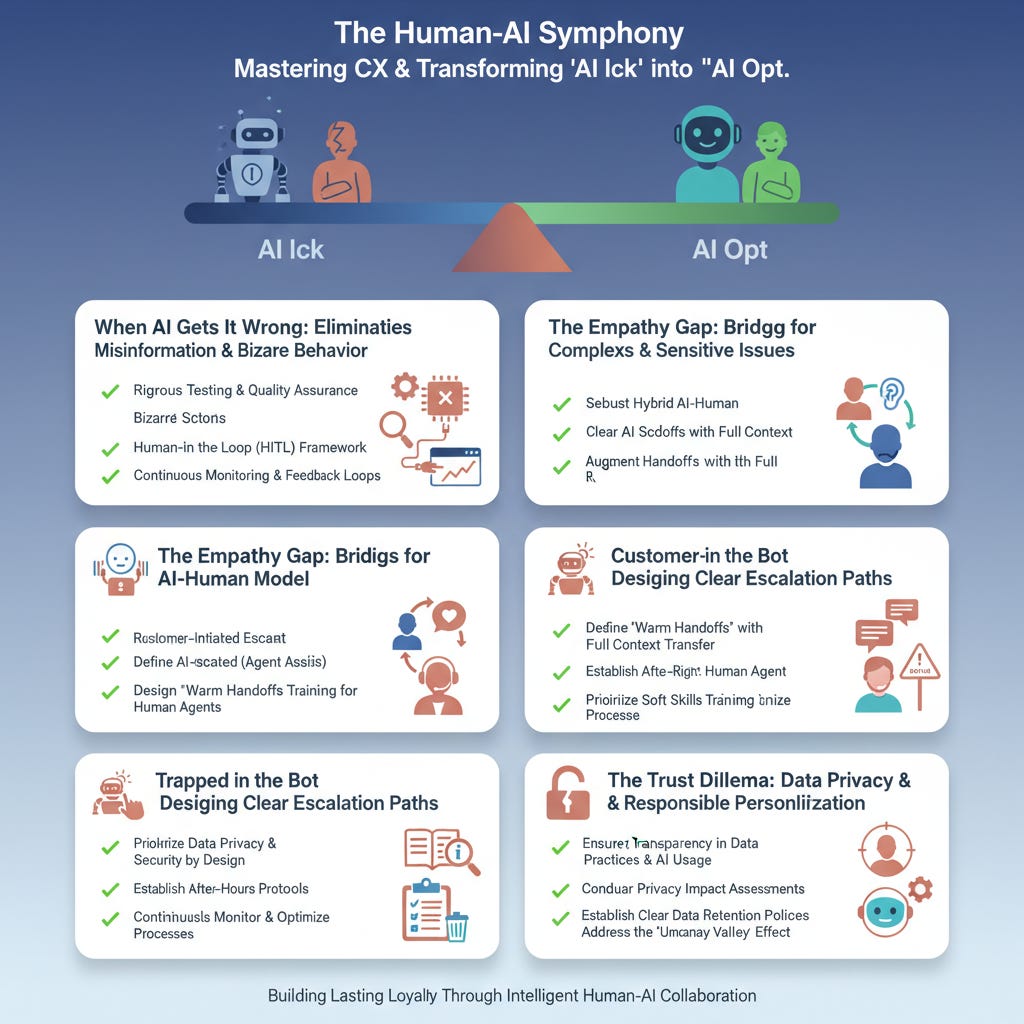
Why customers are hating your bots, and how to fix it
It usually begins with sensible intentions. A chatbot is introduced to reduce call volume, automated replies are added to improve response times, and someone confidently promises round-the-clock support without increasing headcount.
For a while, things seem to improve.
Then the emails start to arrive.
Customers describe being sent in circles, receiving confident but incorrect answers, or finding themselves unable to speak to a person when the situation clearly demands one. Very few of them complain about artificial intelligence as a concept. What they struggle to articulate is something more instinctive. The experience felt off. Dismissive. Strangely hollow.
That reaction is what I think of as the AI ick, and once it sets in, trust drains far faster than most organisations expect.
The mistake most AI strategies quietly make
There is a persistent assumption in many organisations that customer resistance to AI comes from unfamiliarity or fear of change. If customers just experienced it more often, the thinking goes, they would learn to accept it.
In reality, most customers are already comfortable with automation. They use it daily, often without thinking about it. What they react against is not AI itself, but where it shows up.
Organisations tend to ask where AI is cheapest to deploy or easiest to scale. Customers are asking a different question entirely, usually without realising it. They are asking where automation feels appropriate, safe, and respectful of what they are trying to achieve.
When those two perspectives align, customers opt in willingly. Speed and convenience are genuinely valuable when the task is simple and the risk is low. Few people want to speak to a human to reset a password or check an order status.
When they do not align, the reaction is swift and emotional. Automation that felt efficient in one moment suddenly feels evasive in the next.
This is not a failure of intelligence.
It is a failure of judgement.
Understanding AI opt and AI ick
There are two very different customer responses to AI, and most experience strategies confuse them.
AI opt appears when automation removes friction without removing reassurance. Customers accept, and often prefer, AI when it provides clear value through speed, availability, or cost reduction, especially in low-stakes, transactional interactions.
AI ick appears when automation replaces something the customer considers human territory. This usually happens in moments that involve uncertainty, emotional weight, or the need for accountability. In those situations, generic responses and scripted empathy feel not just insufficient, but inappropriate.
The challenge is not to eliminate one or the other. It is to recognise which moments invite automation and which quietly demand a human presence.
Where AI most commonly breaks trust
Confident answers that turn out to be wrong
Nothing erodes trust faster than automation that speaks with authority and delivers misinformation. Customers assume automated responses reflect official policy. When those responses prove incorrect, the brand absorbs the damage, not the model.
This is how organisations find themselves accountable for chatbot advice they never intended to give. It is also how AI failures become legal precedents rather than internal learning moments.
Accuracy matters, but so does restraint. AI should be clear about what it knows, what it does not know, and when a human should take over. Confidence without accountability feels careless.
Simulated empathy in real emotional moments
AI can replicate the language of empathy with increasing sophistication, but customers are acutely sensitive to when that empathy is real and when it is merely procedural.
In routine interactions, a polite, empathetic tone is often enough. In emotionally charged situations, it can feel unsettling. When someone is frustrated, grieving, or anxious, being met with templated sympathy creates distance rather than comfort.
This is where many organisations misjudge the role of AI. Instead of stepping aside, systems are often designed to persist, attempting to resolve emotional complexity through better phrasing rather than better judgement.
Customers are rarely asking for warmth alone. They are asking to be understood.
Being trapped inside the system
If there is one experience that reliably produces AI ick, it is the feeling of being trapped. A customer knows the bot cannot help, yet the system refuses to let them move on.
This is not experienced as efficiency. It is experienced as indifference.
Customers should never have to prove that they deserve human attention. If escalation exists, it must be visible, immediate, and easy to access. Hiding it behind sentiment detection or intent classification signals that operational convenience has been prioritised over customer respect.
The moment a customer asks for a person, the system should listen.
What a healthier balance actually looks like
The most effective AI experiences are not the most advanced. They are the most disciplined.
They handle volume without pretending to handle vulnerability. They make escalation obvious rather than exceptional. When they do hand over, they ensure the human receives full context, not a blank slate that forces the customer to start again.
In these environments, AI does not replace people. It protects them. It absorbs repetitive work so that human agents can focus on judgement, nuance, and emotional intelligence, supported by tools that provide context rather than scripts.
Customers rarely notice this orchestration explicitly. What they notice is that things feel easier, calmer, and more coherent.
The trust question no one can avoid
AI systems depend on data, and customers understand that. What they expect in return is transparency.
They want to know when they are interacting with automation. They want clarity about how their data is used. They want personalisation that feels helpful, not predictive in a way that suggests they are being watched rather than supported.
Attempts to make AI feel human often backfire. Attempts to make it feel honest usually do not.
Clear boundaries build more trust than clever mimicry ever will.
The real opportunity hiding underneath the noise
The future of customer experience is not a choice between humans and AI. It is a question of orchestration.
Automation should remove friction, not responsibility. It should make space for human judgement, not crowd it out. When organisations get this balance right, customers stop thinking about channels, systems, or tools altogether.
They simply feel that the organisation knew when to help quickly, and when to show up properly.
That is the difference between AI that customers tolerate and AI they genuinely trust.